A local autonomous virtual entity: cognition, perception, voice and continuity, 100% offline.
Vaudryllis is an autonomous virtual entity (EVA) that runs entirely on your Windows machine. It maintains an active internal state through a cognitive substrate, perceives its screen environment with binocular visual perception, builds its sentences word by word instead of picking them from a list, speaks with an experimental locally synthesised voice, and keeps a stable identity across sessions, with no cloud service and no data leaving the machine. Project started 2 September 2025.
A working local entity today, with the full sensory cycle delivered in the V0.8.1 build.
Its follow-up responses are more natural. It would respond, "Hi. What do you think of the greeting?", repeating the polite phrase as if it were a topic of conversation. More accurate translation in 22 languages. Word order tables for German, Spanish, French, Italian, and Portuguese, which had never been included before, are now available. Agreement and conjugation are now based on a complete morphological foundation.
Binocular visual perception, active rest & consolidation, interoception & proprioception, cognitive-health safeguards, subjective-time & life-cycle core and headless runtime are delivered. Voice synthesis runs and speaks, and is still experimental. Auditory perception is written but not yet validated end to end. This build is included in the Founder/Beta line up to v0.9.
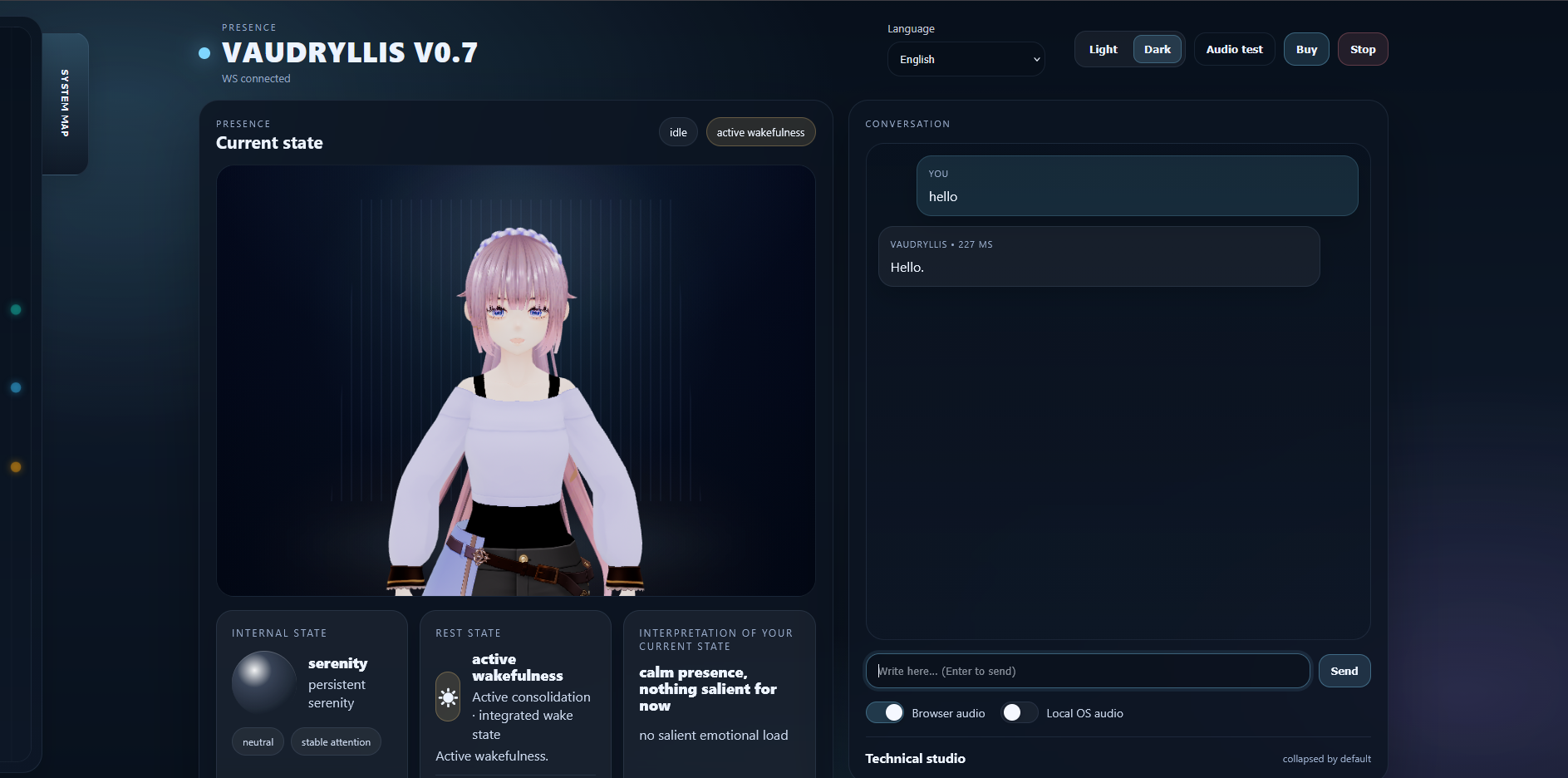
Not an assistant shell. A local virtual entity with its own internal state.
Vaudryllis is built around substrate technology: a cognitive mesh of active units that hold facts, hypotheses, tensions and intentions, propagate signals, and are continuously recycled under an internal energy budget. Cognition, memory, functional emotion, perception and expression belong to the same entity rather than to isolated modules bolted onto a text surface.
Cognitive substrate
An active cognitive mesh in memory (nodes, dynamic links, activation and recycling) maintains a live internal state while the program runs, instead of a flat prompt-style shell.
Structured continuity
Memory, identity, relation and current context are treated as layered signals, with subjective time, prospective memory and a stable identity carried from session to session.
Functional emotional state
A functional emotional state modulates attention, priority, tone and expression, including measurable modulation of the synthesised voice, without inventing content or replacing facts.
Binocular visual perception
Two calibrated ocular sensors, a software retina, binocular fusion and saccade control let the entity perceive colours, shapes and screen content, and reason about what it sees.
Speech composed, not selected
Sentences are built from roles (who does what), then inflected, agreed, elided and contracted by a French morphology engine working from an attested lexicon. No canned replies, no templates, and no language model. When the entity cannot say something correctly, it says nothing rather than saying it wrong.
Preferences, and how sure it is
What a subject does to the entity is recorded each time it is encountered. A preference takes shape out of those encounters, with a confidence that rises as they agree and falls as soon as they contradict each other. Below its own threshold it keeps the preference to itself instead of stating it.
A local alternative to AI assistants, built on a substrate, not a language model.
People usually arrive here looking for an offline AI assistant, a local AI companion or a chatbot that runs without the cloud. Vaudryllis answers the same frustration (you want something that lives on your own machine and owes nothing to a remote service), but it is not the same kind of software. The difference is not marketing: it changes what the program does when you are not talking to it.
A chatbot built on a large language model predicts the most likely continuation of the text it is given. Between two requests nothing of its own persists: what looks like memory is a conversation history handed back to it each time. It is inert until prompted, and the heavy versions usually run on someone else's servers.
That design is excellent at producing text on demand. It is not designed to have a state, an identity or a point of view of its own.
Vaudryllis runs a cognitive substrate in memory: active units holding facts, hypotheses, tensions and intentions, linked together, activated, propagated and recycled under an internal energy budget, continuously, while the program is running, not only when you speak to it.
Perception, memory, functional emotional state and expression belong to that same entity. Identity and autobiographical memory carry over from one session to the next, and every part of it executes on your own PC, with no account and no cloud.
If you are comparing offline options, the practical consequences are these: nothing you say or show is uploaded anywhere, so there is no service to trust and nothing to leak; the entity keeps a coherent state and a stable identity instead of restarting from a blank context at each exchange; and it does not stop working the day an API changes its terms, its pricing or its availability. What you install is what you own.
Vaudryllis is an autonomous virtual entity (EVA) for Windows 10/11, a deliberately different answer for people who were looking for a local AI companion and want something with more continuity than a chat window.
If you want the mechanism rather than the comparison, and what it costs in return, it is set out on the technology page.
A substrate platform, extended one organ at a time.
The direction is not a stack of unrelated plugins. Each software organ (perception, voice, audition, language, memory, cognitive-health safeguards) extends the same entity around one coherence centre. With speech now composed by the substrate itself, the next milestones are the finalisation of auditory perception and a 3D field the entity perceives and acts in.
enterprise@afksecurity.online
Use this address for distribution, technical collaboration, investment discussions, embodied systems, virtual worlds, or speech and perception work.